Christian practices
The role of the church in the local and worldwide community
The importance of the worldwide Church including:
• working for reconciliation
• how Christian churches respond to persecution
• the work of one of the following: Catholic Agency For Overseas Development (CAFOD), Christian Aid, Tearfund.
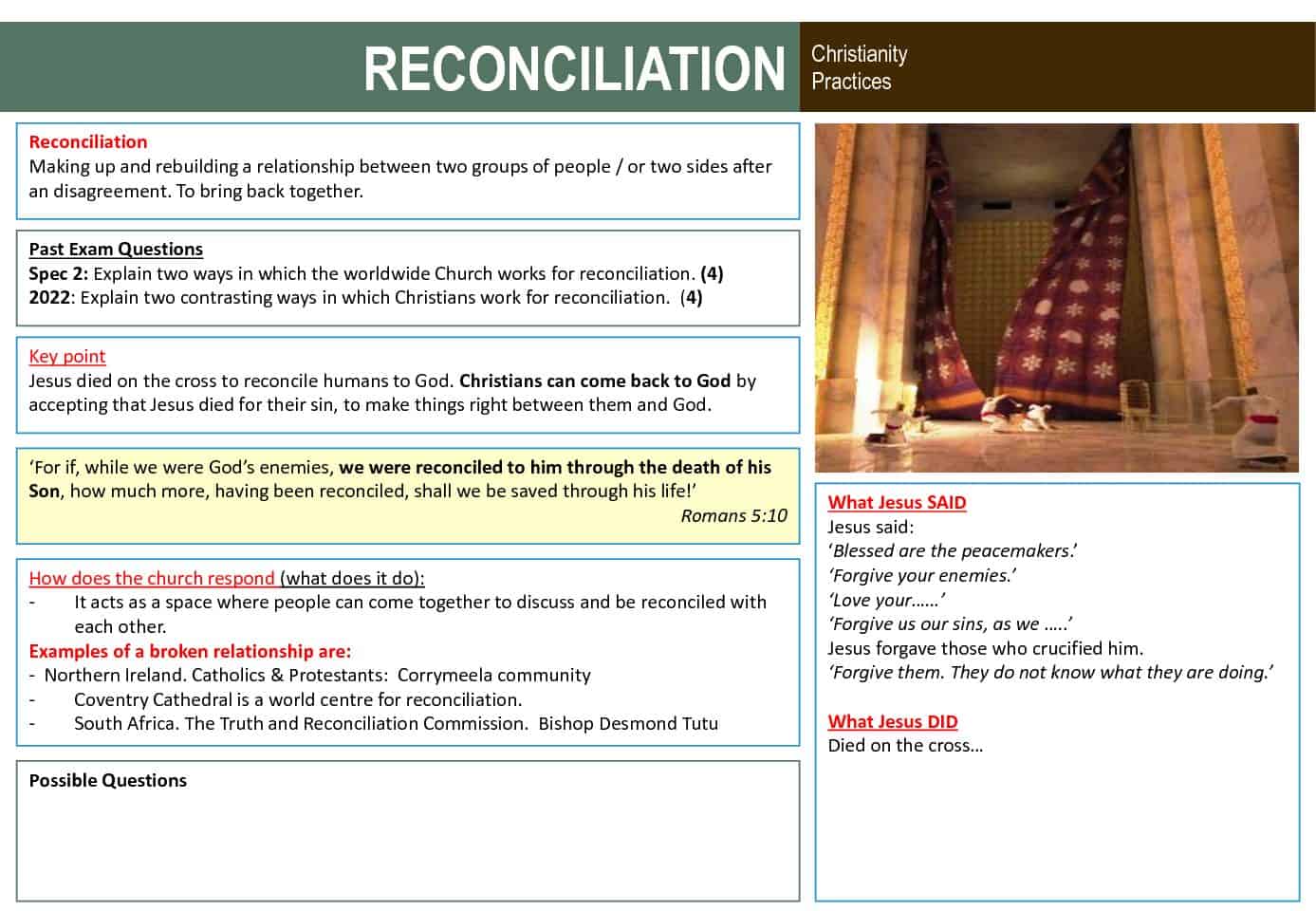
Reconciliation
Explain two ways in which the worldwide Church works for reconciliation. (5)
2018
- The worldwide Church aims to follow the example of Jesus in restoring the relationship between God and humanity / for example in South Africa, Archbishop Desmond Tutu has spent most of his life trying to reconcile the black and white communities, following decades of racial discrimination / Some Christians in this situation opened themselves up the possibility of death / In John 15:12-14, Jesus says: ‘Greater love has no one than this; that one lay down his life for his friends. You are my friends if you do what I command.’
- Reconciliation might be needed between different sections within the Church / eg between Catholics and Protestants in Northern Ireland / The Irish Churches Peace Project aims to reconcile these differences / Forgiveness is important in such situations / and forgiveness is at the centre of the Lord’s Prayer (‘forgive us our sins, for we ourselves forgive everyone indebted to us.’ (Luke 11:4) / The Corrymeela Community aims to bring about reconciliation in Northern Ireland by healing religious and political divisions in the community.
- Reconciliation after war is particularly important / for example local Christians in Coventry aimed at forgiving the Germans for their bombing of the city and the cathedral / and the rebuilt cathedral now stands as a world centre for reconciliation / The Cross of Nails in the centre of the altar cross is a reminder of the crucifixion of Jesus in the Gospels / and of the Christian belief that Jesus died in order to reconcile God with humanity (eg Colossians 1:19- 20), etc.
- Reconciliation may involve ‘making things better’, for example after war: eg restoring food supplies / establishing justice and equality (Oscar Romero) / removing the distinctions between rich and poor. Reconciliation can also involve: the operation of worldwide charities such as Tearfund, which aids those who are being persecuted, eg refugees in Southern Sudan fleeing civil war.
Explain two contrasting ways in which Christians work for reconciliation. (4)
2022
• Reconciliation can take place in many different contexts / for example in restoring food supplies and other essentials after a war / eg Oscar Romero’s emphasis on establishing liberation, justice and equality / and trying to remove the distinctions between rich and poor.
• Some might refer to the work of worldwide charities such as Tearfund / which helps those who are being persecuted.
• Reconciliation refers to restoring right relationships where co-operation, peace and harmony are at risk or have broken down / one example of this is the Ecumenical Movement, founded 1910 / whose work includes bringing different Christian denominations closer together.
• Another approach is taken by Interfaith Wales / which works to reconcile members of different faiths / in the wake of the 9/11 attacks in 2001.
• In the wake of the bombing of Coventry Cathedral during World War II / the rebuilt cathedral itself became a world centre for reconciliation between enemies / the cross of nails (made from nails in the rubble of the roof) is used as a major symbol of peace and reconciliation across the world / copies of the cross were given to Kiel, Dresden and Berlin (cities reduced to rubble by Allied bombing) / as symbols of peace and reconciliation.
• The Council of Christians and Jews (founded 1942) works to remove misunderstanding between Christians and Jews / and to promote reconciliation between the faiths / on the grounds that they are ‘children of one God’.
• Archbishop Desmond Tutu for decades attempted to reconcile the black and white communities in South Africa / following decades of racial tension and discrimination through apartheid / when Nelson Mandela became South Africa’s first black president, Mandela appointed Tutu as chairperson of the Truth and Reconciliation Commission.
• The Irish Churches Peace Project aimed to bring about reconciliation between Catholics and Protestants / emphasising that forgiveness is at the heart of the Lord’s Prayer / The Corrymeela Community aims to bring about reconciliation / by healing religious and political divisions in the community.
• Personal acts of reconciliation eg some Christians may use confession, etc.
Poverty
Explain two ways in which CAFOD or Christian Aid or Tearfund helps the poor. (5)
2023
CAFOD (Catholic Agency for Overseas Development)
• CAFOD, as the name says, focuses on overseas development, particularly Africa, South America, Asia and the Middle East.
• Its focus is on action without reference to faith, gender, or ethnicity.
• It aims to help those who suffer in any way / God intended the world’s resources to be for everybody / Pope Paul VI said that aid is not a case of giving a gift to poor people but giving back to poor people what was already theirs.
• It deals with emergency situations, poverty, war, climate change, famine, discrimination.
• It develops access to clean food and water / medicine / shelter / education / healthcare / programmes and services for the poor.
• CAFOD looks to provide supplies during crisis incidents / to help people rebuild their lives in the years that follow disasters overseas.
• It aims to equip communities to help themselves.
• It helps communities to rebuild after war / famine / disaster.
• It lobbies governments for funding.
• It lobbies employers to provide fair working conditions for their employees.
• CAFOD encourages Christians to pray for others living in poverty abroad / as they advocate that no one should be left without the support required to live life with dignity.
• Catholic parishes and schools support with prayer and money, etc.
Christian Aid
• Christian Aid provides both immediate and long-term aid where appropriate.
• Since the refugee crisis at the end of World War II, its aims have been to expose poverty and help to end it.
• Christian Aid asks world leaders to reverse climate change by changing from the use of fossil fuels to alternative cleaner energy sources / because climate change hits the poor most.
• It challenges systems that favour the rich and powerful at the expense of the poor and marginalised / for example tax-dodging.
• It tackles the sources of poverty / for example lack of education / poor farming techniques / poor health care / lack of clean water.
• It works to encourage Christian communities, churches, and individual Christians to hold poor communities abroad in their prayers / and provides example prayers to be used relating to worldwide social justice and development.
• It aims to bring immediate relief for those impoverished by disasters such as hurricanes and tsunamis.
• It helps communities to develop long-term self-sufficiency by improved food production.
• It helps the poor to sell their produce at a fair price / and to gain access to services and finance.
• It concerns itself with helping those with nutritional problems, malaria, and HIV, for example / and offers assistance with maternal and child health.
• It works with other organisations to fight poverty, e.g. Fairtrade Foundation & Stop Climate Chaos.
• It sends envelopes annually to all UK households to collect money for all its efforts to fight poverty, etc.
Tearfund
• Tearfund is an alliance of evangelical churches / it aims to help the very poorest people / such as those in the Biafra crisis of 1968 / it looks at global issues.
• It aims to care for people’s spiritual and physical needs / focusing on where the need is greatest.
• It goes to places of need in order to change poverty / eg by self-help by building wells for clean water / financial help by lobbying UK churches who put on events.
• It puts a major emphasis on prayer.
• It also focuses on what Jesus did, and aims to bring help to those who need it the most.
• It is not a charity / the focus is to promote self-help wherever possible.
• It encourages young people to help by taking a gap year to take part in various projects / going on mission trips.
• It focuses on creating churches as the centre of local communities / and has created around 70,000 churches in the last 5 years, etc.
Sources of authority might include:
‘If you give a banquet, don’t invite friends or rich neighbours, invite the poor, the lame and the blind, then you will be repaid at the resurrection.’ (Luke 14:12-14)
‘You lack one thing, sell what you have and give it to the poor.’ (Mark 10:21)
‘Blessed are you poor, for yours is the Kingdom of God.’ (Luke 6:20)
‘The Spirit of the Lord is on me, because he has anointed me, to proclaim good news to the poor.’ (Luke 4:18)
‘And the king will answer them, “Truly I tell you, just as you did it to one of the least of these who are members of my family, you did it to me”.’ (Matthew 25:40)
‘So faith by itself, if it has no works, is dead.’ (James 2:17)
‘But when you give alms, do not let your left hand know what your right hand is doing, and your Father who sees in secret will reward you.’ (Matthew 6.3-4)
‘Whoever is kind to the poor lends to the Lord, and will be repaid in full.’ (Proverbs 19:17)
Persecution
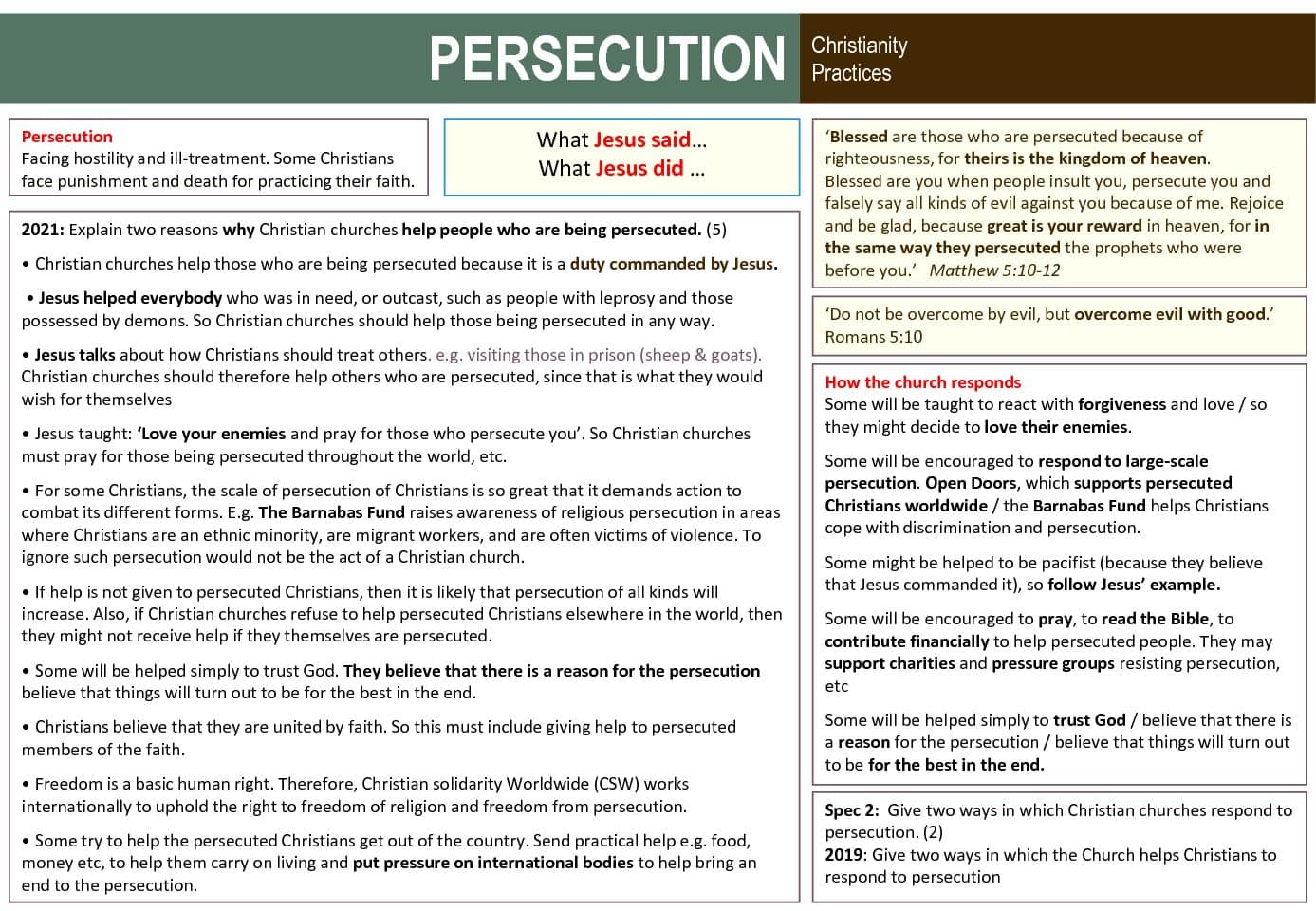
Give two ways in which Christian churches respond to persecution. (2)
Spec 2
- Pray for themselves and others being persecuted/try to help the persecuted Christians get out of the country
- send practical help eg food, money etc, to help them carry on living
- put pressure on international bodies to help bring an end to the persecution/try to continue with their faith in quiet, unobtrusive ways, without drawing
attention to themselves or other Christians, etc.
Give two ways in which the Church helps Christians to respond to persecution. (2)
2019
• Some will be taught to react with forgiveness and love / so they might decide to love their enemies.
• Some will be helped simply to trust God / believe that there is a reason for the persecution / believe that things will turn out to be for the best in the end.
• Some will be encouraged to respond to large-scale persecution, eg James & Stephen Smith set up the Aegis Trust to prevent genocides/atrocities such as that in Rwanda / also eg Open Doors, which supports persecuted Christians worldwide / the Barnabus Fund helps Christians cope with discrimination and persecution.
• Some might be helped (for example) to be pacifist (because they believe that Jesus commanded it) / they might follow Jesus’ example.
• Some will be encouraged to pray / to read the Bible / to contribute financially to help persecuted people / to support charities and pressure groups resisting persecution, etc.
Explain two reasons why Christian churches help people who are being persecuted. (5)
2021
• Christian churches help those who are being persecuted because in effect it is a duty
commanded by Jesus’ teaching / one main text that underpins this duty is Matthew 5:10-12: ‘Blessed are those who are persecuted because of their righteousness, for theirs is the kingdom of heaven. Blessed are you when people insult you, persecute you, and falsely say all kinds of evil against you on my account. Rejoice and be glad, for your reward is great in heaven.’ / so enduring persecution brings the reward of heaven.
• For some Christians, the scale of persecution of Christians is so great that it demands action to combat its different forms / for example, The Barnabas Fund raises awareness of religious persecution in areas where Christians are an ethnic minority, are migrant workers, and are often victims of violence / to ignore such persecution would not be the act of a Christian church.
• Jesus helped everybody who was in need, or outcast, such as people with leprosy
(eg Mark 1:40-42) and those possessed by demons (eg Mark 1:23-27) / so Christian churches should help those being persecuted in any way.
• If help is not given to persecuted Christians, then it is likely that persecution of all kinds will increase / also, if Christian churches refuse to help persecuted Christians elsewhere in the world, then they might not receive help if they themselves are persecuted.
• Christians believe that they are united by faith / so this must include giving help to persecuted members of the faith.
• In the Parable of the Great Judgement (Matthew 25:31-46), Jesus talks about how Christians should treat others / eg visiting those in prison / Christian churches should therefore help others who are persecuted, since that is what they would wish for themselves.
• Christian virtues include: love, compassion, sympathy and empathy / virtuous behaviour must therefore include helping those being persecuted in the worldwide community.
• Freedom is a basic human right / so (for example) Christian solidarity Worldwide (CSW) works internationally to uphold the right to freedom of religion and freedom from persecution.
• Jesus taught: ‘Love your enemies and pray for those who persecute you’ / so Christian churches must pray for those being persecuted throughout the world, etc
Resources
Videos